
YA LA’FORD
Kaleidoscope
The Spirit within the Geometry of Wind, Water, and Dreams
Curated by Jocelyn Boigenzahn
October 9–December 11, 2026
Scarfone/Hartley Gallery · The University of Tampa
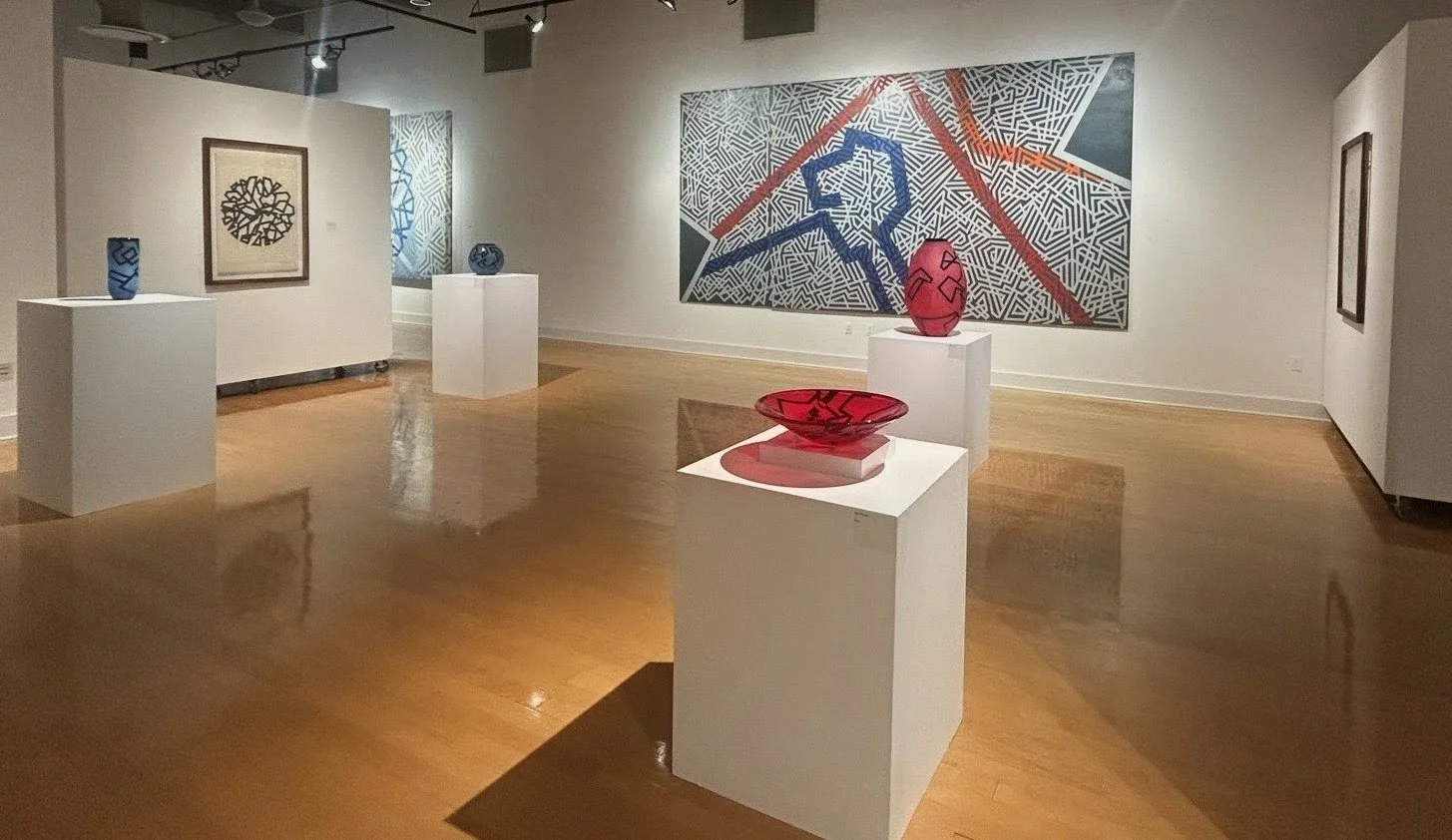
Ya La’Ford’s Kaleidoscope: The Spirit within the Geometry of Wind, Water and Dreams explores how patterns and shapes can give form to experiences that are difficult to hold still.
Throughout the exhibition, La’Ford uses grids, circles, pathways, and labyrinths to consider memory, spirituality, transformation, and our connection to place. Lines gather like currents, while circles and pathways suggest cycles, journeys, and return.
A kaleidoscope creates its geometric and color-rich patterns through mirrors and light. As the device turns, those same elements shift into new arrangements. La’Ford’s work invites a similar experience. Familiar forms repeat and recombine, taking on different meanings through their scale, placement, and relationship to one another.
The exhibition invites you to slow down, look again, and make your own patterns. As your perspective rotates, forms shift and transform, much like wind moving across a landscape, water forming new streams, or a dream taking shape before fading upon waking.
Plan your visit
Gallery hours
Monday–Friday, 10 a.m.–5 p.m.
Location
Scarfone/Hartley Gallery
R.K. Bailey Arts Studios
310 N. Boulevard
Tampa, FL 33606
Admission
Free and open to the public.
Artist talk
Friday, November 13, 2026
2–3 p.m. · Scarfone/Hartley Gallery
Free and open to the public.
-
Encountering the Structure of Movement: Ya La’Ford’s Kaleidoscope
Jocelyn P. Boigenzahn
A kaleidoscope brings fragments into a pattern that changes as the device turns. The pieces remain, but their relationships shift with each adjustment. Ya La’Ford’s Kaleidoscope: The Spirit within the Geometry of Wind, Water and Dreams uses this idea to introduce a changing view of the exhibition. At the Scarfone/Hartley Gallery, circular sculptures establish lines of sight through the space. Looking through an opening reveals another work; moving to one side changes the alignment. Orientation and perspective are part of the installation’s design. Visitors discover connections through where they stand, where they look, and where they choose to go next.
The exhibition offers several routes rather than a single sequence. A sculpture may draw attention across the room, while a nearby painting encourages a pause. Repeated circles and angular lines help visitors recognize relationships between works encountered along the way. These forms appear in wood, glass, metal, and paper, as well as prints and mixed media paintings. Each material changes how the pattern is seen. La’Ford’s geometry gives the exhibition continuity while inviting comparison among individual pieces.
Making those comparisons gives La’Ford’s philosophy of connection a practical form in the exhibition. Her recurring geometric paths invite a reading that connects individual experience with shared encounters. In the gallery, visitors take an active role in this process. A familiar shape may connect two artworks, recall a place, or prompt a conversation. The exhibition gives people common points of reference without requiring them to reach the same interpretation. Its references to wind, water, and dreams offer ways to consider how movement and memory influence these encounters.
Beyond Form makes the relationship between movement and looking particularly clear. This freestanding wood sculpture belongs to the series of circular works that establishes views through the gallery. Its patterned sections partly block the room beyond, while its openings reveal selected portions. As visitors approach or move around it, the view changes. Shadows on the wall and reflections on the floor extend the pattern beyond the sculpture itself. These effects encourage attention to the work’s surroundings as well as its physical form.
Bruno Latour’s writing helps explain why this arrangement matters. He considers how objects participate in human activity by enabling or redirecting what people do.1 In this exhibition, a sculpture’s position influences the route someone takes; an opening draws attention to a work behind it. The installation therefore helps shape the conditions of a visit. Visitors make their own connections, but those connections develop through an encounter with objects that guide and sometimes interrupt their view.
Color becomes more prominent in Suspended Spectrum, a tall blue glass vessel with raised black lines and finer etched marks. Its curved surface asks visitors to look from more than one position. A line disappears around the body, and following it requires a small adjustment. The viewer remembers one part of the pattern while seeking its continuation. This introduces a simple relationship between looking and time: understanding the work develops across several views.
The vessel also provides a way to consider water through geometry. Its lines change direction and divide the surface into passages that the eye can follow. They can suggest a current finding a route around an obstruction. Similar changes of direction occur in the exhibition’s prints and paintings, although their patterns remain within a flat surface. La’Ford’s fixed lines make movement imaginable through the act of tracing them. Their association with water depends on this experience of flow and interruption, without requiring a literal image of a river or wave.
Tim Ingold’s studies of lines connect drawing with walking and other activities that develop through movement. He also describes our knowledge of an environment as something learned through bodily experience, including walking and breathing.2 His work helps relate the exhibition’s patterns to the visitor’s route through the gallery. Following a line with the eye and finding a path around a sculpture both require adjustments of direction and attention. These familiar activities connect La’Ford’s geometry with the ways people experience the natural world from within it.
Wind introduces a related idea. We often perceive its movement through its effects on something else. In Beyond Form, openings and cast shadows draw attention to the relationship between the object and the space around it. This offers an association with air and passage, even though the sculpture does not move. Alexander Calder’s mobiles provide a useful comparison: their suspended forms respond physically to air currents, allowing a composition to change over time.3 In La’Ford’s stationary sculptures, the visitor’s changing position alters the view. Both experiences depend on time spent looking and on the relationship between a work and its surroundings.
The pace changes again with In the Dark II. Made from etched paper and presented in a gold frame, the work requires close attention to differences within its dark surface. Angular paths and smaller marks become easier to distinguish as the viewer studies them. The experience is less about finding a new position than allowing time for details to emerge. It can recall the effort of recognizing something partly seen or recovering an incomplete memory. Geometry provides a route through the image, but the response can be emotional as well as visual.
This connection between form and inner experience belongs to a history of spiritual abstraction. Hilma af Klint used geometric and organic shapes in the spiritual inquiry of her Paintings for the Temple.4 Wassily Kandinsky also explored how abstract forms could affect thought and feeling. His Several Circles (1926) creates a sense of suspension and movement through circles of different sizes arranged within a dark field.5 These artists approached spirituality through distinct beliefs and methods. They provide a historical context for considering how geometry can address experiences that are difficult to represent directly.
In La’Ford’s exhibition, spiritual reflection can begin with the attention a work requires. A circle may suggest continuity or return; a branching pattern may prompt someone to think about a journey or a choice. Such associations remain open to the visitor’s experience. La’Ford’s interest in individual and shared paths brings the discussion back to human connection. A personal response can become part of an exchange with someone who notices a different detail or remembers a different place.
The reference to dreams extends this role of association. As visitors move among the works, a shape seen earlier may return in another material or setting. Recognition may be immediate, or its source may take time to recall. Gaston Bachelard’s writings on water and air consider how material experience continues through imagination and reverie.6 La’Ford’s recurring geometry can prompt a similar process. A line in glass may recall a sculptural shadow; a pattern in paper may bring an experience outside the gallery to mind. These connections need not follow the order in which the works are displayed.
The visitor’s journey thus includes both physical movement and shifts in memory and attention. Water offers a comparison for routes that divide and continue around obstacles. Wind suggests movement understood through its effects. Dreams connect impressions outside an orderly sequence. La’Ford brings these ideas into contact through repeated forms that remain fixed while the experience of them changes. The natural references are grounded in activities familiar to viewers: moving through a place, noticing relationships, and remembering what they have seen.
Looking with another person can expand that experience. A shared observation may lead back to a work already passed or make an unnoticed relationship clear. This gives La’Ford’s philosophy of connection a practical role in the exhibition. The works support individual reflection while providing a setting for exchange. Their repeated geometry offers enough familiarity to sustain a conversation, and their differences in material and form give that conversation something specific to explore.
The catalogue provides another opportunity to consider these relationships. Individual images allow close attention to a work, while installation views show its place among other pieces and the routes around them. Readers can move between those views, compare patterns, and reconsider an earlier impression. This continues the exhibition’s invitation to make connections through looking. La’Ford’s work brings geometry, human experience, and the natural world into a shared field of attention, leaving each reader room to consider how those relationships take shape.
Notes
Bruno Latour, “Where Are the Missing Masses? The Sociology of a Few Mundane Artifacts,” in Shaping Technology/Building Society: Studies in Sociotechnical Change, edited by Wiebe E. Bijker and John Law (Cambridge, MA: MIT Press, 1992), 225–258. See also Reassembling the Social: An Introduction to Actor-Network-Theory (Oxford: Oxford University Press, 2005).
Tim Ingold, Lines: A Brief History (London: Routledge, 2007); and “Footprints through the Weather-World: Walking, Breathing, Knowing,” Journal of the Royal Anthropological Institute 16, supplement 1 (2010): S121–S139, https://doi.org/10.1111/j.1467-9655.2010.01613.x.
Alexander Calder, “What Abstract Art Means to Me,” The Museum of Modern Art Bulletin 18, no. 3 (Spring 1951): 8–9; Achim Borchardt-Hume, ed., Alexander Calder: Performing Sculpture (London: Tate Publishing, 2015).
Tracey Bashkoff, ed., Hilma af Klint: Paintings for the Future (New York: Solomon R. Guggenheim Museum, 2018).
Wassily Kandinsky, Concerning the Spiritual in Art, translated by M. T. H. Sadler (New York: Dover Publications, 1977); Tracey Bashkoff, ed., Kandinsky (New York: Solomon R. Guggenheim Museum, 2009).
Gaston Bachelard, Water and Dreams: An Essay on the Imagination of Matter, translated by Edith R. Farrell (Dallas: Pegasus Foundation, 1983); and Air and Dreams: An Essay on the Imagination of Movement, translated by Edith R. Farrell and C. Frederick Farrell (Dallas: Dallas Institute Publications, 1988).